Episode Transcript
[00:00:02] Speaker A: You are listening to Portobello Talk Radio, the authentic voice of Letbrook Grove.
Hello and welcome to Great Exchanges.
My name is Piers Thompson and Great Exchanges is a collaboration between Portobello Radio and Imperial College London. This series brings together scientists and community voices to to explore the ideas that shape our everyday lives.
Ahead of the Great Exhibition Road Festival on June 6th and 7th this year, we take conversations sparked by the festival program and bring them into dialogue with local perspectives and lived experience.
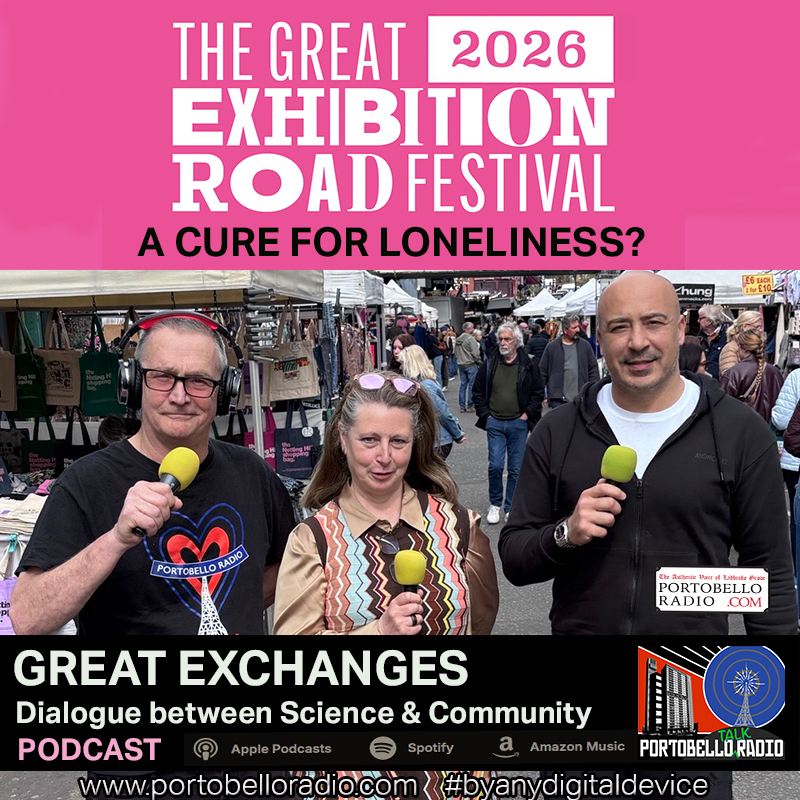
In this episode, we turn our attention to loneliness.
It's a growing public health concern that affects people across all stages of life, often quietly and unseen.
Joining the conversation is Dr. Austin L. Oster, Director of Imperial College London's Self Care Academic Research Unit. Austin helps us explore why loneliness matters, how it differs from social isolation and why social connection is fundamental to both mental and physical health.
We're also joined by Mindy from Maxilla Men's Shed in North Kensington. It's a community led space where men and women come together to share skills, build friendships and find a sense of purpose. It's like repair shop under the Westway and it offers a powerful example of how local initiatives can challenge loneliness through connection, routine and belonging. Together, our guests explore how research and grassroots action can complement each other to offer practical insights into how we might feel more connected in our own lives.
I'm joined today by Dr. Austin Eloster, who's the director of the Self Care Academic Research Unit at Imperial. Welcome.
[00:02:07] Speaker B: Morning. Good to be here.
[00:02:08] Speaker A: Thank you. And we're also joined by my neighbour, Mindy Mayer. Welcome, Mindy.
[00:02:12] Speaker C: Good morning.
[00:02:13] Speaker A: Mindy, you live opposite me and at the bottom of your block is the Men's Shed.
I came in and found you there. Tell us a tiny bit about the Men's Shed.
[00:02:24] Speaker C: It started a few years ago.
The Men's Shed is an organization started in Australia and called the Men's Shed because it was mainly for men who had retired and didn't know what to do with themselves.
But in this area there's a lot of women that go there as well and we can. There's lots of tools there that you can make anything you want to do. There's a wide range of things that you can do from making furniture to jewelry, clothes making.
And it's also a community space where a lot of people go very regularly and we've got to know a lot of people that are local and also not so local and it's a really nice space to come to.
[00:03:19] Speaker A: Yeah, I mean, I popped in the other day and it's like Repair shop isn't in there. Yes, Austin, we're here to talk about social connection and self care. What, what are the, what are the most pressing health and care concerns which can be mitigated?
[00:03:37] Speaker B: Well, there are many health and social care concerns these days. They've been around for a long time. And I think what we're seeing now is an explosion of what we call, you know, lifestyle diseases or diseases of lifestyle or non communicable diseases, things like type 2 diabetes, which are largely preventable, some types of obesity and other diseases. So and these are really related to our sedentary lifestyle and the way we live today and the food we eat. But there's also a tsunami, an epidemic really of mental health that some of it is stigmatized and not talked about. One of the really big pressing health concerns now is, you know, loneliness and social isolation. And these have been around for a long time. Things we call wicked problems that we can't just throw money at and wish to go away. But I think the COVID experience of lockdowns has taught us how lonely people can feel. And I think now there's an awareness that loneliness is a public health concern that needs to be looked at in society and in big cities like London.
[00:04:34] Speaker A: The Self Care Academic Research Unit.
What are you guys working on at the moment?
[00:04:39] Speaker B: So we're doing a lot of work. We're trying to consider the totality of self care. But increasingly now behavioral science is of course trying to understand where people are, what are the drivers and barriers for people to adopt health seeking self care behaviors. Why is it that some people are better at self care than others? And what can we do to democratize access to self care interventions, products and services. So there are many work streams we're working on, including the measuring loneliness in the uk, the Interact Study, which is the largest global study on social connection. So we already have 230,000 people in that study and we're doing a lot of work with collaborators nationally and abroad to understand loneliness in a new way and what place based interventions can be developed to support people who may be suffering in silence. So very exciting for our unit at the moment and we're delighted to be working with other universities as well and voluntary sector organizations which give us access to specific communities whose voice is very important.
[00:05:42] Speaker A: And the 230,000 people you're working with, are they all elderly or do they cover the spectrum age wise?
[00:05:50] Speaker B: So the Interac study is recruiting anybody who is 16 years or over in the UK. We're lucky to have engaged with some Many participants, we got ethics approval from the NHS Research Ethics Committee, which means that GPs can contact their patients using a letter or an SMS. We also have approvals from Imperial College Ethics Committee, which means we could engage with communities, social media and so on. But unfortunately, although we've got a lot of participants and from different sort of age groups and walks of life, the challenge really is we don't have a perfect cross section. So in the UK, you've got, what, 60 something million people, so you can't get everybody in that. But it's really about raising awareness about loneliness and this topic is here to be discussed. And we have a Minister of Loneliness who recently gave us an address in the uk, recently installed. And we have wonderful organizations like the Campaign to End Loneliness, who are doing excellent work to.
To help people become more aware of the interventions that are relevant to them.
[00:06:54] Speaker A: Mindy, you live in one of the blocks on our estate and there's always.
There are 80 flats and in there there are people who maybe sometimes hardly ever come out.
[00:07:11] Speaker C: Recently we've had a problem with the lifts due to regenerating the estate, and we started a petition and we sat at the bottom of the block of flats and there were people that came in and we were asking them to sign and I might have seen them at a distance or passed them coming in and out, but then we started chatting and weirdly, it was a nice experience.
And also, I've been there 20, nearly 26 years, but because I didn't bring up children there or grow up there, there are a couple of people that I know just from locally, but I wouldn't know anything more about them, so we just pass in lifts, etc.
[00:08:00] Speaker A: I mean, that. That's an interesting point, Austin, because we're here and in fact, the estate where we live, they tried to knock it down about 10 years ago and that did bring us all together.
We also had the Grenfell fire, of course, which was an appalling event, but it was amazing the way it brought the community together.
Now, a lot of the people who are listening to this won't have had that kind of really intense event to bring them together.
So if you're living somewhere that hasn't been affected by tragedy, what are the sort of things that we can be looking at?
[00:08:41] Speaker B: I think people would experience loneliness throughout the life course. Probably most people dip in and out of it. It's just being aware that there are moments when it can become a more pressing issue to the individual and you need to look to friends and to your support mechanism to make sure that they could help you re engage and just get out of your shed, so to speak.
[00:09:03] Speaker A: I mean, a lot of people who are depressed probably aren't 100% aware of the fact that they're depressed. They just, they feel down.
[00:09:13] Speaker B: I mean, indeed, it depends how depression has come about. So you may just wake up and have a bad day. You may have circumstances that are quite difficult, bereavement or otherwise sort of slowly get you into that state. And there's a type of organic disease that depression can be really rooted after a while and that will really change the way you behave and your lifestyles and that can actually end up making you lonely or isolated. So depression is quite common. There are treatments for it.
One of the most amazing things we hear about depression and social connection and things of the mind is being aware of your state of mind, being aware of your mental health and well being is so important.
Recognizing where you are on the scale of mental well being is important because if you do need support, you can reach out and say, I'm not feeling well. Can you help? Now these interventions can be very simple. Simply talking to a friend sometimes you may need some professional help.
So awareness I think is the key bit here. And this reflects back to the pillars of self care. The key in the ignition of self care is health literacy and awareness. And the second pillar is mental health well being. There are other pillars we can talk about later as well. But recognition of mental health being something that could change over time and that you have to a large degree an empowerment to actually change the state of your mental health through social connection is very important.
[00:10:33] Speaker A: At the men's shed, there are a lot of people there who maybe have recently been bereaved. You know, men whose wives may have died or vice versa.
There are people who are caring for an ailing relative or spouse who probably because they're tied to the home, they don't get out.
I'm thinking there's a lovely chap called David for instance, who comes in from. I think it's acting every day that that's one of the joys of the med shed, isn't it?
[00:11:05] Speaker C: Because it takes you away from your everyday life.
And also you saying that has sort of made me think we don't really talk about personal things so you're not pulled back into whatever rut that you're in.
We, we get on with doing things. And Ellie, the lady that runs it is really, really nice. She's so patient and helpful and it gets you out of your head.
[00:11:38] Speaker A: Basically, one of the things that there is a lot of provision for around here is mindful gardening. And that's another brilliant way of bringing people together, volunteering to get.
The only thing is that if you are depressed, you. You just don't have that spark to get out of your door and go downstairs and down the road to whatever option may be available to you.
[00:12:04] Speaker B: Absolutely. There are many interventions and things that people can do to get out of being lonely or depressed. But how do you actually identify these people in the first place? And what types of conversations can you have with them? And even if you were to say, look, how about we go to this mindful garden center or the men's shed, Some people may be reluctant to do that depending on where they are. So there isn't going to be one size fit all solution. But I think having these conversations important. It also depends on the type of person you're dealing with. There are people who are what we call activated. They recognize they're in a bit of a pickle. They want to get better. Things are hard and they may commit to engage in something that will take them out of that zone. But there are others because of other determinants or really difficult crisis that would be in a much more difficult place. And I think there isn't going to be a single recommendation. So I think having these community assets and communities is very important.
Raising awareness about Men's Shed and other sort of activities and interventions is going to be important. If you don't know about them, you may not. You're not going to stumble upon them by mistake. Rarely you find people going online because they're depressed so they could find something to make them happier. So there isn't going to be a solution to all of this, apart from the person recognizing where they are and hopefully having a social network that could help them in a time of need, maybe help them out of the house and show them that life could be different.
[00:13:29] Speaker A: The accepted wisdom in many ways is this is an issue that affects men more than women. Is that actually true?
[00:13:38] Speaker B: Absolutely not true. I think that everybody suffers mental health and loneliness or isolation at times. But there is definitely a difference in how it's stigmatized in men and particularly in some groups of men.
Some men may find it quite embarrassing to talk about their mental health or depression, depending on what culture you're from as well. Depression and mental health doesn't exist, of course. This is just something in the mind that you have to sort of deal with.
Men may feel that they're responsible, that the paid the patriarch and the family, they have to be strong. And, of course, you know, the experts will tell us that this puts them in a difficult position sometime. And, you know, what we find is men who have a very good social network, they go for football or go to the cafe together, they're more likely to sort of have that support mechanism.
[00:14:23] Speaker A: Mendy One of the things that's great about the men's shed is you don't actually talk about loneliness or social isolation. It's simply, have a cup of tea, you know, come and join our repair shop. Do you feel like when people like Prince William or Harry Styles talk about mental health, does that encourage men to come out of themselves, or is it just a celebrity mouthing off?
[00:14:51] Speaker C: I think that probably a lot of people think it's celebrity.
They don't understand what it means not to have money or not to have the opportunity to do things.
And if you really think about it, everybody's the same and we all have problems.
And sometimes having money brings problems that you don't have. If you're just everyday person,
[00:15:20] Speaker A: does that make sense to you? Austin?
[00:15:23] Speaker B: Absolutely. I mean, recognition that mental health is, you know, everybody experiences some type of depression, mild depression, probably, or loneliness and so on. So I think that's understood. We also don't want to be tokenistic about it, to have some very famous people, just, I'm the patron for this and that. But you have very sort of people like Robbie Williams and others, we know they've suffered, they've come out to say that we've had issues and others, even Prince Harry, for example, you could imagine that the things could be tough for individuals.
So there is a recognition that mental health is here.
At the same time, you don't want to be hearing too much about it because it does bring you down.
The idea of these discussion points is that mental health is something that people should be aware of. In schooling, at university, when you move out of the home for the first time, you may be having to budget. Money could be tight. One of the biggest challenges, I think, for some people growing up is not having a partner, for example, they may be surrounded by people and that may cause them to feel depressed. So, you know, when you talk about depression or loneliness, you know, they're all connected to some extent. Some people become lonely because they're depressed or vice versa. So having people talking about it on television, radio is very important. We also need sensible solutions, policymakers, of course. I mean, we have the NHS and social care services.
[00:16:34] Speaker A: Do you think people are unnerved by the idea that their depression or their loneliness, which they may not even recognize that it might need pharmaceutical interventions in order to cure it or help with it.
[00:16:54] Speaker B: One of the hallmarks of clinical depression, which is a deeper depression, is people may not actually recognize they're depressed. It goes so far into depression that they think that it's just the way they are and they become sort of cognition sufferers and so on.
So these are people who might benefit from pharmacotherapy, for example. They're different treatments, but on the whole, if we not discuss that class of individuals who are deeply depressed, it's true that people wouldn't immediately want to start medication and the GP ordinarily wouldn't immediately, sort of. If they go to say I'm depressed, it's probably a social prescribing touch point here to understand more about why they're depressed and what can they do, given their lifestyle and the communities that they have and where they are. Is there something like a Zumba lesson? A cycling club? Is it a recent bereavement that they have to just process?
But there are people, of course, who do need pharmacotherapy and there would be treatments available for them. And, you know, you could argue that globally there's an overuse, probably of antidepressant medication, and that's an interesting topic, but it's there for people who need it and will benefit from it.
[00:18:04] Speaker A: Do you take a big effort for you to go out and join in, or are you just a sociable person?
[00:18:13] Speaker C: That's quite funny, actually, because I was very, very quiet when I was younger and what Austin was just talking about, I've been through the system.
I've done quite. I've had quite a lot of therapy over the years, and personally, I'm very open to that. But what you were saying about men's health, I know that there were members of my family, male members, that really were shut off to that did not want to engage with that at all.
[00:18:49] Speaker B: Just hearing you talk about this, Mindy, I think I'm just. Where there's a recognition that there are different types of people in the medical terms, there's something called the patient activation measure.
Patient. They're people. If you take 100 people from the community, you would find some people that are very activated, not just physically they want to go out, but actually they want to get better. They never miss an appointment when they're given a gp. They take the medication on time. In medical terms, that's great because these people respond faster and better to treatments, whatever domain. But There are also these people who are less activated for whatever reason. They could be very literate, educated, they could not have any of the wicked problems we discussed. But they're more apathetic, they normally respond slower to treatments, they might miss an appointment.
And equally, when you talk about communities and mental health and how engaged you are with society, there are people who are a bit more introverted and people who are more extroverted. Mindy doesn't strike me as very extroverted, but I imagine you're very sociable and well liked and I think how the community reacts towards you is very important because you can have the best intentions. I want to go out, I want to make friends, I want to engage, but you may find that this group isn't for me and you're getting the signal, so you have to look elsewhere. So having hobbies, having assets and things you can do in the area is important. That's why, for example, living in London may be a good thing for some, but not for others. Others may prefer to live in a village where actually they know their neighbors, whereas here you might live in a building with 50 apartments and not really know half of these young people who live next door.
[00:20:24] Speaker A: We're very lucky here, actually, because, again, as a result of the fire, we have this thing called the Grenfell Health and well Being Service, which I actually. I mean, I have therapy there every, every week. And it's unlike the National Health Service, it doesn't end after six appointments, so it can actually develop in an organic way. I've also done the NHS six sessions, and it's extraordinary the way you get to the end of the six sessions and you're kind of thrown out on the street again.
Is there anything we can do about that?
[00:20:57] Speaker B: Just hearing you say this reminds us of how important it is. You know, the sessions, you don't swallow a blood pressure monitor, you don't eat the psychologist. It's that discussion you have with them that gets you to process these thoughts and maybe for the first time talk about them. Because we often think about the things that make us worried or depressed or anxious, but we rarely talk about them or journal them. So having these conversations with a professional is really important because that's the way probably it works. You process the information, you talk about it and you bring out the demons, so to speak, and there's light there, so you can begin to tackle the problem.
So, I mean, these treatments are great, the psychotherapy is fantastic.
I think it's underutilized because many people who don't aren't depressed. They may have some, some knots that they could untangle probably with using good conversation. Which brings us back to the importance of having friends. These are things you can invent or buy. These are things that have to develop organically and it's a trial and error. So when you go to university, for example, you realize that very quickly you have these groups forming right in the first sort of couple of months and then the who do you live with? Who do you end up with? It's a bit of a lottery as well. No. So having friends is really one of the most important root benefits really to mental health and well being and having these treatments like talking therapies now with online modality, they're becoming a bit more accessible in different languages. But nothing beats face to face sort of conversation over a cup of tea.
[00:22:32] Speaker A: In this series, you know, we've, now we're on the fourth season, we've talked quite a lot about the concept of social prescription. You can't socially prescribe friends.
[00:22:42] Speaker B: Indeed. And that's why the men's shed is important and other sort of infrastructure and socializing and otherwise. I think the drop down menu of social prescriptions is increasing. Governments are investing in, policymakers are investing as you're prescribing and I think increasingly we'd find that gps would be able to signpost you to more services than what we have now. But again, it's a postcode lottery. It depends where you are and what services are around you. So having all these excellent charitable organizations and community centers in this area and elsewhere is really important.
And that's what really would make a difference to, you know, intergenerational stuff. So we're not talking about a specific cohort. If you're younger, you might want these sort of options. If you're older, an older adult would have specific needs that could be met through these social prescriptions.
[00:23:32] Speaker A: Mindy, the traditional British social prescription is a cup of tea, isn't it?
[00:23:38] Speaker C: Yes.
[00:23:39] Speaker A: I mean, going back, let's have a brew, let's put the kettle on. That's a key part of the men's shed.
[00:23:45] Speaker C: Yes. Is actually. Yes. I find myself going to the kitchen to put the kettle on quite a bit.
Almost automatic. Not all cultures are the same, but it is just a form of being generous. Just like other cultures, feeding people automatically to, you know, bring out food, etc. I find in this area that people go out to have tea or coffee. It's more coffee around here.
[00:24:18] Speaker B: And hearing you say that just makes me think that absolutely some People would prefer tea or coffee. But it's not about the drink, isn't it? It's structured. Come, let's have a cup of tea. And that means something in the back of the mind probably that we're going to meet at one point, we're going to spend some time together and we're going to have a drink, whether it's tea or coffee. And a conversation must happen and that is a natural transaction. So. So it becomes an excuse to engage with an individual. So.
[00:24:42] Speaker C: Well, yes, it was a very social thing to go to your local pub, which there are less of. And in Portobello Road there were more bars and a lot of those have gone and they're not so local anymore. A lot of people that I might meet or friends would meet in a local, they're not there anymore. People have moved away and I think that's an age thing as well that,
[00:25:14] Speaker A: that of course, the pub is the other social prescription in the uk.
And Mindy, you're so right because when I used to live at the top of the road, there was the Carnarvon Castle and that was full of. There was death's waiting room, they used to say, same with the Pelican. And the only one left really is the Pig and Whistle, which is constantly full of 65 to 75 year old men. The racing's on, you know, everyone's having a laugh. We're losing a lot of these community spaces that people get used to before they get lonely.
[00:25:50] Speaker B: Absolutely. I think society is changing. The way we live is transforming. You know, the idea of a template society is long gone. I think there is a British culture, there's a London culture, Portobello has a unique culture, but that will slowly change. And culture is the slowest to change, but it's always changing.
[00:26:06] Speaker A: A lot of people are quite right in saying that the loss of things like youth clubs means that that sense of sociability is being lost from quite early days, from teenage days.
[00:26:18] Speaker C: Also breakup of families because families aren't staying in the same area because London's got so expensive, so aunts, grandparents have to move out.
So do you don't have older elders, older people to kind of guide them?
[00:26:39] Speaker A: And the estates over in Latimer, they would have four generations of families living on the same estate, which, you know, all those things like someone's ill, someone's got to go to the pharmacy, you know, someone's child needs looking after for two hours while I go and get my hair done. All those things are being slightly lost to us.
[00:27:02] Speaker B: Yeah, this is a contemporary issue with online, with digital. I mean, some kids just don't want. They prefer to be online. They prefer avatars than having real people around them. They prefer to play games with, you know, people from other countries because they know them really well, because they spend hours gaming with people in. In other countries, for example. But they might not have a very good social network here. So youth clubs are great in principle, but again, it won't work for everyone.
We talked about, for example, how people can be quite peripatetic. They're moving around quite a lot. I mean, I went to 18 schools to give or take throughout my life, which is quite difficult. I wish I still know all of my friends, but there are people who've gone to the same school with others and they've grown up together in the community and they're probably very deeply connected. And I think these are the things, examples that still exist but are becoming rarer. So youth clubs are important, although people are probably, if you ask a young person now, they probably, some of them may say, actually it's nice, but I'd rather, you know, I've got my small. I've got my way of dealing with community universities as well. Whether you go to university or not is another thing. You make lifelong friends. Usually it's a very formative time of your life.
The jobs that you get, you know, jobs and careers are different, but you get little jobs that you meet people along the way. So that continuity. And London is a very mobile place. I mean, you know, people change housing now. They sort of.
People don't want to live with their parents for too long and then you leave the house and you have to, of course, work and earn money and sort of. You have to sort of grow up a little bit. So life could be hard. Having a youth club is great, but I think there may be an association or a stigma that some youth clubs are for people who might be, for example, offending or great for people who need a bit of support because they haven't got the support.
So how you conceptualize youth clubs to people and how they sound to others is going to be very important. Maybe calling them something else may help. So that's why team sports are great and arts clubs are brilliant.
[00:28:54] Speaker A: One of the reasons, there are many reasons why people end up not leaving the house. You know, they become scared of the outside, they get. Lose the habit of going out. You know, we don't need to go to the paper shop anymore because it's all online. So you're not even Saying hello to the news agent.
How, how can we help people get out of their silos?
[00:29:18] Speaker B: Okay, so I think there's a resurgent awareness about what people can do to help themselves. Generally in public health, we've forgotten about self care because we haven't talked much about that. The idea that all this type of care that we could really help ourselves by doing the seven pillars of self care, mental well being, health literacy, healthy eating, physical activity, avoiding risks wherever they are, good hygiene practices and the biggest pillar of all, which includes headphones, the rational use of products and services.
So medicines, technology, digital parks, green spaces, communities and men's shed. So being aware of these particular of self care is very important. And recognizing that there's a life course approach, you know, your needs change as you get older. If you're young, it's about having a community that loves you. If you're old, you go to university. Sexual health becomes more important, budgeting becomes more important.
Heartbreaks, you know, become more prominent at that time of life, the workplace, when you're working.
So recognizing that life is a game, it's important to understand where you are in this game.
Sometimes we need support, we might reach out for it. It could be pharmaceutical, it could be sort of community.
So for people to get out of their silos, I think recognizing where they are on the mental health spectrum is key because it's a determining factor in mental health. If you're not in a good place, your day is going to be very different. If you wake up very positive and you have something to look forward to
[00:30:44] Speaker A: and mindy, from your lived experience, what is it that helps you to get out of your flat in the morning and go to one of the many activities you choose to partake in or what, What? You know, was there a moment when you were on your own in the flat and thinking, I must get out?
[00:31:02] Speaker C: Oh, definitely, definitely. I know that if I have something to do or somebody to meet changes my whole viewpoint and my whole day. And once I do take part in an activity or get outside, my mood lifts and I feel much, much better. And then at the end of the day I feel that I've achieved something that I haven't stayed at home.
[00:31:31] Speaker A: And what's the first step
[00:31:35] Speaker C: to reach out to your GP if that's easier for you?
There are a lot of services that GP surgeries offer now and just take it step by step and before you know it, that you've widened your circle of friends and activities that you're doing
[00:32:01] Speaker A: and maybe pick up the phone because quite Often, you know, if your neighbour knocks on your door, there you might be sitting there on your own, not answering.
[00:32:08] Speaker B: And that's the key ingredient, belonging. We've talked about that, Mia, that this is important. You feel that you belong is so important because if you don't feel you belong, then there's nothing really to look forward to. You're fighting a world on your own. It's cold. Feeling that you have some friends that you may reach out to, that there are support mechanisms that you can dip into is very important.
And there is on that a reason to be so. Some people, for example, are lucky enough to have a job, they're lucky enough to have a family with problems. But you know, there's something to fight.
Having that vigorous sort of reason to live is very important. So if you're on your own, if you're at home and because of circumstances, it's important to recognize that it's hopefully something you're just passing through and there's a lot that you can do about it to help yourself get out of that space.
[00:32:55] Speaker A: Mindy, thank you so much for coming to join us.
Would you have any other advice for people who may be falling into a trough of loneliness about how they can pull themselves out?
Cup of tea?
[00:33:11] Speaker C: Yes, cup of tea.
To reconnect with people from your past, it's never too late to reconnect with friends or ex workmates, but also via your GP and also to study local colleges, go back to education, something that you wanted to do when you were young and you were working so you couldn't, and to involve yourself in something that you're really interested in.
[00:33:51] Speaker B: And the men's shed, I imagine, I imagine that's going to be a very helpful place. And pottery lessons. I don't think there are any enough pottery clubs in the area. You could do a lot, but the pottery, I think is something that we need more of.
[00:34:02] Speaker A: Learn to learn to throw.
How do we find men's shed? Just menshed.org probably, isn't it?
[00:34:08] Speaker C: That's a really good question.
[00:34:09] Speaker A: Just Google it.
[00:34:11] Speaker C: Yes, Google it. There's a lot of min sheds in London, worldwide, countrywide.
[00:34:16] Speaker A: And you know, you know, social media gets a real bad rep and is responsible for many of the, the ills that we're all suffering from at the moment. On the other hand, going back to that ancient thing, friends reunited, that made me, what you said made me think of that. Or indeed Facebook, you can find people, or LinkedIn, I suppose you can find people from your old work, from your old school, from Your old uni from the neighborhood you used to live in and when you moved out of London, there are lots of people on the kind of born in W10 group who reconnect. They've moved out of town to Harlow or wherever it is, and they reconnect through social media. So we shouldn't dismiss that completely.
[00:34:59] Speaker B: Absolutely. Social media could be great. There are risks, of course, involved and some people may compare themselves to others and feel, actually, I don't belong. You know, they've done so well, I haven't, you know, they're connected. I'm not. I'm. I want to reach out to someone because I'm lonely. You know, how do I actually put it in words? I can't just say, hey, mate, I'm really lonely. I just. Senior for 10 years, please can you cover. But I think that's one component that is going to be helpful. Social media. You can learn about what's around you, you know, what events are there, culture events for free. Right. South bank and Portobello and so on. Or come to the Great Exhibition Road Festival.
[00:35:31] Speaker A: Well, we're going to come to that in a second.
[00:35:33] Speaker B: So there are many, many doors that could open through social media. If you have access. Of course, you know, we haven't talked about the people who haven't got access, but increasingly less and less people don't have access.
[00:35:45] Speaker A: And there is the library. I mean, if you're your local library, almost everywhere that still has a library, there's a very kind person at the desk who will help you get onto the computer and, you know, make those baby steps. Most libraries actually have groups, computer literacy groups for older people. So that's not, probably not a bad place to start and.
[00:36:08] Speaker B: Absolutely. And what, what a shame that many libraries are closing. There are statutory libraries that we must have and the demographics of people who use library has transformed more recently. It's parents with young children trying to induce them to library settings. Or you find older adults who may not have access to Internet at home that need access. So it's not like it used to be. We need more libraries, the most trusted spaces in England, according to many studies, and sort of.
So libraries are great and I think having events in libraries which do happen is going to be great to break the ice, really creating that natural space for a natural transaction to happen. Right. I've seen you before, where do you live? And so on.
So libraries are great. And we have community centers now popping up everywhere in the new NHS that we have.
We have a commission to have community health workers so these are people who aren't necessarily medical, but they do a lot of social prescribing. They are in the community. There'll be more community hubs, we hope, which would incorporate, you know, events from the Men's Shed and sort of other community organisations and social prescribing.
[00:37:14] Speaker A: A great event coming up on June 6th and 7th is the exhibition Road Great Exhibition Road Festival. It takes over the whole of Exhibition Road and the side roads.
It's a fantastic affair. Portsbilla Radio will be hosting the music stage, which we're very proud to do.
You are going to be running workshops or events or what are you going to be up to?
[00:37:38] Speaker B: I'm delighted that I'll be participating. I normally go as an observer and I engage, but this year Skaru is going to be delivering a couple of workshops. So we're going to be in the Science Cabaret, which is going to be talking about a topic, Self Care, on this occasion. And there'll be some colleagues who will be developing some comedy around that topic, which I think is going to be very interesting. There are many, many events, of course, people can sign up to online.
There's going to be hundreds of exhibitions and posters and there's also the Zen Bus which I'll be featuring in. The Zen Bus is an interesting sort of bus that's parked somewhere very colorful and they do a lot of events on mindfulness. There's a well being, sort of drop ins, some yoga sessions and other things. I'll be giving some interventions there, engaging with society, challenging some young people and older people on what Self Care is and if they can do a quiz that would get them a little prize, a colorful prize of sorts.
[00:38:31] Speaker A: Thank you Austin for bringing your wisdom and expertise.
[00:38:35] Speaker B: Thank you for inviting us.
[00:38:36] Speaker A: Thank you Mindy for bringing your experiences and your wisdom to the eight to the issue.
We look forward to seeing you all at the Great Exhibition Road Festival on the 6th and 7th of June.
You can find us on all the socials and you can book free tickets to the most popular sessions on the website. You'll find detailed information there about everything that's going on over the weekend. Portobello Radio is hosting the main music stage right in the middle of Exhibition Road.
Thanks for listening to great Exchanges. It's a Portobello Radio co production with Imperial College London. The other shows are all available wherever you find your podcasts.
You are listening to Portobello Talk Radio, the authentic voice of Lead Brook Grove.