Episode Transcript
[00:00:02] Speaker A: You are listening to Portobello Talk Radio, the authentic voice of Letbrook Grove.
[00:00:12] Speaker B: Hello and welcome to Great Exchanges. My name is Piers Thompson and Great Exchanges is a collaboration between Portobello Radio and Imperial College London. This series brings together scientists and community voices to explore the ideas that shape our everyday lives.
Ahead of the Great Exhibition Road Festival, which takes place on June 6th and 7th this year, we take conversations sparked by the festival program and bring them into dialogue with local perspectives and lived experience.
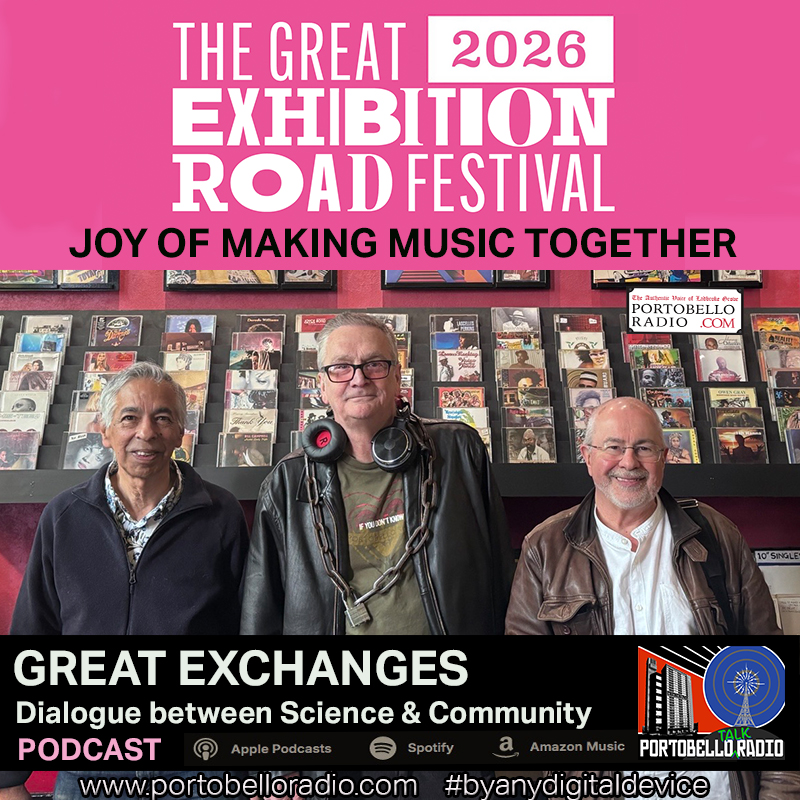
In this episode, we turn our attention to the joy and benefits of playing music together and why making music collectively can have such a powerful impact on connection, trust and well being.
Joining today's conversation is Professor Ian from the University of Cambridge. His research explores the social and cognitive aspects of people making music together. We're also joined by Dr. Haroun Sharn, Director of Nostalgia Steel Band, Europe's oldest steel orchestra. He's appearing on the Joy of Playing Music Together panel at the festival.
Together, our guests explore what happens when people come together in time and how shared rhythm and collective participation can build social bonds, create belonging and sustain cultural heritage.
Joining us today is Professor Ian Cross from the University of Cambridge. Welcome.
[00:01:42] Speaker A: Thank you very much.
[00:01:44] Speaker B: And we're also joined by Dr. Harun Shah, founder and director of Nostalgia Steel Band.
[00:01:51] Speaker C: Can I just. Hello to everybody. Just to make one correction, I wasn't the founder.
I've been a director, the founder. The band was founded before I even arrived in London in 1964. I didn't come until 67.
[00:02:06] Speaker B: We're talking about the joy of playing music together. What do we actually mean by that? What is happening between people during that performance?
[00:02:17] Speaker A: A whole range of different things which we can look at or try to explain at a whole range of different levels.
Socially, behaviorally, it's fun. It literally is fun. We're playing together.
A reversion to childhood, if you like.
We're doing things together that don't have immediate utility that we can just revel in. At another level.
There are things that are. When we make music together, it's a non conflictual mode of interaction.
It's a way of interacting with other people that almost guarantees we'll get on with them.
And that means that there are things happening neurally and at the endocrine level, hormonally, that are often common between participants but are often oriented towards positively valenced emotional states. Happiness.
[00:03:17] Speaker C: Happiness.
[00:03:17] Speaker B: That's what we're all about.
Harun, does that tally with your experience playing and running a steel band?
[00:03:26] Speaker C: In principle, it's very similar, but I think the experience of a steel band is very different.
An orchestra and in a steel band, because you're not playing from a written score, you playing by memory, by rote.
I think that bond and that feeling is even stronger because you would have somebody coming off the road who is an individual that have never seen played an instrument before, as opposed to somebody else who's played another instrument.
And what I've noticed over the years that these were not barriers, they actually harmonize quite quickly.
And you find that because you play in by rote, however good somebody might have a good memory, you play and follow each other quite closely. So I, I think it might be even more dramatic, that sort of collectiveness that you see in a steel band compared to what my daughter says who played in an orchestra.
[00:04:31] Speaker B: Picking up on that. Does, does it make a difference what kind of music you're making? I mean, if I'm a punk band, four piece punk band, maybe not very good. Is that very different from being an elite jazz man?
[00:04:47] Speaker A: Not really, no.
The point about something like playing in an orchestra is that you're in a quite specific, complicated hierarchical social structure.
You know what your role is and that's what you have to do.
You could say that the same thing is happening in for instance, a string quartet.
You've got the music written out, but actually when you look at what happens between the members of a string quartet, they're doing exactly what heroin suggested is going on in the steel band. They're making time for each other, they're listening to each other, following, leading, etc. There's always this issue of this process that's mediated by reciprocity, that I'm following you, you're following me.
It's a mutual, a mutual thing.
Whereas very large scale ensemble like an orchestra, you are following the conductor, or the members of a section are following the leader of the section.
But even there, you're getting some elements of that reciprocity.
This is something that's just beginning to be explored experimentally. As you can imagine, it's really complicated.
If you were to try and wire up all mighty members of an orchestra, the amount of data, how do you coordinate that it's being done.
That work is just beginning to be undertaken and it's gonna be interesting to see what comes out of it.
[00:06:21] Speaker C: Can I just follow that for a minute or so? One of the times when we needed to record and there were just 50 of us individual microphones was for the opening ceremony of the Olympics. Our band Nostalgia was selected. There was a piece of Music written. And we all had to do this for the first time. It took us five hours literally for everybody to understand for the first time that you were playing as an individual. And we struggled, we really struggled.
Luckily, I mean, we had a great conductor and the composer. But five hours when we knew this simple piece of music should have taken us 15 minutes.
And before he was happy with everything.
And even then he had to electronically slow and mesh things together before the final record went out for the Olympics.
[00:07:19] Speaker A: It depends on what you're used to.
I'm thinking of an occasion where for experimental purposes, we had to take members of a Cambridge college choir in into my studio and record them on individual microphones.
They couldn't do it.
I mean, these are people who were singing every day a world famous choir.
But take them out of the context, that big acoustical context where you, you sing a note and it washes around. Put them in a studio where there's no reverberation whatsoever and all they can hear for the first time ever is their own voice. They out of tune, out of time. It took about 20 takes to get a quite simple piece. So it depends on what you're used to. You just take the musician at the context and it's like taking a snail out of its shell.
[00:08:10] Speaker B: Does it make a big difference if people know each other before they embark upon playing together?
[00:08:18] Speaker C: I'm not sure that that really makes a difference.
I think especially perhaps more so in a steel band where again you're playing by. You become almost a different person inside there.
You have a friendships outside that's different and you have a friendship within the band that I think is even closer. It's really quite tight. Are you looking at even people's body language where their hands should be and so on and you coordinating something more holistic than a friendship? Individual outside is quite different.
You know, again, we saw this when we tried to do a recording once with a completely different band.
We go every year. We used to alternate with a band in Germany and we sent the music in the way that we would write it recordings. And whenever we met each other, it still took like a full six, seven hours before the two bands were synchronized and playing properly. So I, I think there is something in that room that playing together is really quite a unique experience that builds up periodically and groups of people play better when they start playing together. Understanding what each other would do.
[00:09:42] Speaker A: Yeah, absolutely. Because I think one of the things that happens is what you could call joint agency, that when you're playing with a group of Musicians or when you're playing with another musician and you do so over a long period of time, you can find yourself performing and you're not quite sure who's playing what, but it doesn't matter because you're together doing it. And your contribution, or, sorry, your capacity to introspect about your own contribution is limited because you just. It's. It's what's been described as we intentionality rather than I intentionality.
[00:10:23] Speaker B: Does, does language, does the spoken language make a difference? I mean, I. If you take two people who speak English, for instance, with people who speak a romantic language or Arabic or something, do they. Do they have any added barriers to being able to talk together in music?
[00:10:45] Speaker A: Well, it's really the musical culture that underlies their experience.
So for instance, an Indian musician will engage with pitch in somewhat different ways from someone who's brought up in a Western tradition and so.
Or someone from Turkey. Turkey is a really interesting case in point because you get this mix of east, west there, makam tradition and Western tradition mixing together.
You get some really interesting music coming out of Turkey. It's not so much language, it's cultural background, preconceptions and whatever it is that's guiding what you experience as predictability.
And that could be, in a sense, some sort of barrier.
If the music is doing things and going in directions that are kind of vaguely familiar but ending up somewhere different from what you might expect, then that's a little bit of a barrier.
But for the most part, I don't think language really plays a significant role in mediating people's capacity to interact in music.
[00:11:57] Speaker C: I mean, in nostalgia. As the oldest steel band in the uk over the years, it started with mostly Trinidadians and then others from the Caribbean. And in later years I am the only Trinidadian. My daughter, they come. People come from all over the world, a lot of Latin Americans, East Europeans and so on. I've never found the language itself to be a problem.
What could be a problem is the rhythm, because sometimes rhythm is buried so deeply into you that I think it's so easy to run off into what is innate.
The Trinidad, because of the long process in which the steel ban arrived from emancipation basically going through to a period of indentureship. You know, it was only seven years difference between freedom, emancipation in 1838 and the arrival of the first Indians en masse to grow on the tea plantation. And they obviously had a big influence on the music that was developing. Plus we had the strong influence of Latin America with Cuba, particularly Venezuela. The early Steel band music was a lot of Latin American, Venezuelan music.
All of these rhythms had something. But there is one defining rhythm that comes straight back from Africa, that you cannot mistake it. We had two, three years ago, we had one of these conferences in Ghana. And when we arrived at the airport in Accra in Ghana were 40 big drums, only beating. And my daughter just grabbed on to me and she said, dad, that is calypso.
And I said, yes, that's where it came from. And that rhythm is staying true. And if you listen to steel band, iron, that beating, that rhythm, I've never heard it anywhere else in any type of music. It's so. So engulfs the steel band, the instrument. Now, I find the same thing, like when I go to Brazil, their rhythms are very complex and in some. And I. I find it like I miss a note off and on. It's. It's. It's very difficult. So I think the two. The language itself is not a problem, but. And even the performances itself, but the rhythm, if somebody moves, I find from the instrumental percussion, I think you've got to concentrate a lot harder, in my opinion.
[00:14:40] Speaker A: Yeah, I think a lot of the rhythm is quite literally in the body.
And in fact, if you look across world cultures, there are many cultures that really don't distinguish between music and dance, particularly in Africa, for that matter, there are cultures which don't really have distinct terms or frameworks for thinking about music and dance.
Same goes for indigenous Australia.
Song and music in indigenous Australia is song and dance. It's not one or the other.
So you could think of the two as necessarily connected. And in the context of something like the Latin or African rhythms that are key to steel band tradition, that really works in the body. You have to dance the right way to play the instrument.
[00:15:29] Speaker B: So you. You've mentioned reciprocity and. Which I'm slightly translating as consideration for others. I mean, you particularly think of some of the jazz greats who play unbelievable solos and then hand over to another jazz great who then plays a complete, completely different, but compatible solo. Can you play music if you're a selfish person?
And would that selfish person get the same benefits from playing together as well as we would?
[00:16:03] Speaker A: Let's see, it's not something we've ever experimented on. It's quite difficult to ask someone, are you a selfish person?
To identify your sort of experimental group.
But what I meant by reciprocity was something actually much, much simpler. So if two people are trying to keep in time with each other, just tapping on the table or something, and One gets a little ahead a little too fast, the other person will try to compensate, and the person who was originally a little ahead might then compensate. Then they might both decide, okay, we're a little too fast now and both slow down. So there's this process of mutual co adjustment that is always going on and it's an integral part of musical interaction. If you're just focusing too much on your own part and not aware of what else is going on, you can get really quite out of time quite quickly.
So one of the key elements is to be able to do what you're doing, but be aware of what other people are doing, doing and how what you're doing fits with them and vice versa. And that's really what I mean by reciprocity.
[00:17:12] Speaker B: Is there something about being in time with each other that appeals to our
[00:17:18] Speaker A: inner self very straightforwardly? If we're in time with someone else, that enables us to predict what they're going to do, or rather when they're going to do what they're going to do.
It's something that happens in language, in conversational interactions.
We discovered for instance in one of our experiments that when two people are just chatting and it's just hanging out, shooting the breeze, whatever you like, they're not talking about anything, they're just talking for the sake of talking. And one asks a question and the other responds. You can predict the temporal location of the first speech, accent of the response from the last two or three of the the question.
And if they're disagreeing it'll be out of time.
So there is this type of reciprocity, temporal reciprocity going on in, even in conversation.
And it's key to music. Basically. Music and conversation are pretty much the same thing or rest on the same processes. And those processes are all structured around time and an awareness of time and a sharing of time between participants.
[00:18:35] Speaker C: Yes, I mean just to go back a little bit about perhaps what, how you define what selfishness might actually mean. But that works to advantages certainly in the development of any. Anything, whether it be a scientific experiment or so, you know, universities, guard departments guard their work. And so you. That selfishness is actually because you are worried that I think somebody will surpass you. And music is no different. If there's a competition, when there's a competition on, in, in Trinidad they used. There's a competition that starts off the carnival. We have it here in London now as well. It's called Juve, the start of the whole process.
And each band has to play something that's unique.
And they are so secretive about it. They don't even play with the sticks. They touch their fingers so nobody could hear.
Competition is almost necessary. It does not mean that you actually, you know, lose friendship. And along the line that everything that we were talking about and following up on what Ian had just said, sorry, but I think that as I mentioned, the whole juve competition, where the music has got to be the word they use, it's a bomb. You drop this bomb to the public and it's still called that. Although it's about, gosh, 80 odd years old, they still use that word and they still use it in London as well. And that's the element of surprise.
So if there's an element of surprise, competitiveness comes in. But the competitiveness still does not detract from the fact that within that ensemble, within that group, whatever, the cohesion, collectiveness is very, very, very strong. It's competition to win against the other band. And what I was just saying that from that I think develops many new aspects because people learn from each other. Why did so and so win? What did they have that was so special?
So it does introduce that element of it. But on the whole I'd agree with what Ian said. I think the collectiveness is always strongly there.
[00:21:01] Speaker B: It seems to me from what you're both saying, that being in time instills a certain level of trust within the group. Is that. Would that be what's happening?
[00:21:12] Speaker A: Yeah, very much so. I think we did some experiments. One of my graduate students about 12, 15 years ago, looking at the development of empathy in children aged between about 8 and 13, which is run about the time when children are most likely to change in their level of capacity for empathy with others.
And what my student Dahen did was developed a little program of musical group interaction games, kind of reciprocal games for small groups of children. And we found that for those small groups of children, the change in huge change in capacity for empathy, much more so than amongst children who didn't do this.
So there is a close bond between, a close association between the capacity for empathy, pro sociality, sense of connectedness and music being in time, sharing time effectively. When we do something with someone else and we are sharing a temporal framework, we feel that they are more like us. And it's usually reciprocal. There's a reciprocal sense of similarity and commonality.
[00:22:37] Speaker B: You mention children and I mean, I remember going, when my daughters were at Oxford Gardens School, up the road, they had an orchestra that must be about 9, 10 years old.
The music was. It's Very sweet. But it was horrendous. It was really terrible.
Does that still engender the same feelings of empathy and trust and ending up with joy?
[00:23:08] Speaker A: Actually, yeah.
If one thinks about what is the function of music? What are the functions of music?
One is to create extraordinary sound.
The other is to create social relationships, to help social relationships play out.
So when we're making music together, we can think of it as either resulting in some sort of abstract, wonderful aesthetic object, or in the production of social relationships, the enhancement of social relationships between participants. That's something that was identified by an ethnomusicologist called Thomas Torino, who's worked across the Peruvian Andes, Zimbabwe and in North America. And it's common across all forms of collective music making that to make music, in making music together, the purpose might be as much social bonding as it is what we might think of as making music.
[00:24:14] Speaker C: Making the sound, I mean, it depends on what stage it is. I would have to say in the early days, when you get a group of youngsters, I mean, we do workshops all the time.
And in that case, I totally agree. And the fact that people playing, they're coordinating together, there's a great deal of fun, there's a great deal of excitement. But I think beyond that stage, when you have a bad day, you feel very upset with yourselves afterwards, actually. I mean, I've known we'd gone out to times and people played badly, and somebody said we really didn't enjoy that performance.
So I. I think that's a natural sort of human reaction to this. But.
So it depends, I. I think entirely, if. If it's something that you perform in, you're going out, you, you, you have a gig, you paid for it, you expect, and you want to do well. And particularly if you have a concert and you feel you've been let down, some of the notes were not tuned badly, could affect a more advanced group. But in the early stages, I think the bonding, the getting together is really critical and that understanding each other is really quite important.
[00:25:32] Speaker B: We're very lucky around here. We have. We've got Nostalgia, we've got Mangrove, we've got Emily, we've got Metronomes, Glissando, and all of the bands are teaching young people all the time. Time. Whether it's Matthew from the tabernacle going into the primary schools, whether it's Pandeva teaching the children at the back of the tabernacle. Why do so many young people join the bands? Is it. Is it for the sense of comradeship? Or do they know that they are trying to achieve that synchronicity.
[00:26:08] Speaker C: I mean, in this area, you have the presence of Notting hill, Cardiff, well, 60 years this year, and it's become the Steel Pan over the years now, focusing entirely on the Steel Pan. And in fact, here has become so associated with our identity, it is why Notting Hill Carnival started. It was a steel band that started and it came in response to, you know, blatant racism in the area. I stayed here one night, I remember, and the house was burnt and I never came back to the area. It was a very bad time. And when Claudia Jones called the community together and said, well, what do you do? How are we going to. The answer is not to pick up guns. The answer is to find it and let's turn towards culture.
[00:26:55] Speaker A: Music is diverse.
There are so many different musics in the world, but the one constant is that it's all human beings doing it. Every human being on earth can be musical. Sometimes you might not want to listen to what they do, but everyone can join in.
[00:27:13] Speaker B: I was just thinking then of football crowds, for instance, with that. That amazing sense of togetherness. If, you know, very few people can sing very well, a lot of it's out of time. Quite often one half the crowd's slightly out of time with another one. But there's a sense, there's a sense of belonging, there is a sense of joy. And are you releasing endorphins?
[00:27:39] Speaker A: Oh, absolutely. If you've got 5,000 people singing more or less the same thing, that's pretty powerful. It's a fabulous feeling.
It's also quite threatening to the opposition.
There are instances where you. You get football crowds or football ultras who are musical ultras. They'll get together beforehand and make up songs about the opposition, often pretty obscene.
And when that's sung by three or four thousand people, that's quite pointed. It's very definitely we are us and you're not.
That's a way that music is and can be used.
But the basic function of music, I would say, is to express sociality, to express community.
[00:28:30] Speaker C: But I mean, it can be used in, as you say, in a threatening way as well. You know, ancient, older armies without the drums and perhaps the trumpets and so on, stirring up people to go into battle.
It's shown, it's proven over that time that it. It can raise that level of whether they. Endorphins or dopamines actually do make a big deal of difference.
[00:28:56] Speaker B: No, absolutely. I mean, the Red Coats, of course, as they came over the hill, were playing the Pipes and banging the drums and probably singing and probably not singing actually.
[00:29:06] Speaker A: It's quite difficult to aim when you're singing.
But certainly keeping in time, which is really one of the primary functions. If you get a whole mountain mass of people moving in time, that itself is pretty threatening.
[00:29:20] Speaker B: Some people I, I'm. I mean I'm a dj, but I consider myself as completely unmusical. I, I do, I mean I through football really as much anything else. I do understand the joy of being at one with however many other people. Does it make a difference if you're musical or non musical, how much joy you can expect extract from playing?
[00:29:43] Speaker A: It depends what you mean by musical. I mean that that really is a, a culturally loaded category.
I would tend to not even think about musical versus non musical but just degrees of immersion in a dominant or alternative musical culture and degree of engagement in western cultures.
Particularly over the last 50 years it's become increasingly the case that music is something that's consumed and musical engagement is the act of musical engagement. Playing an instrument, singing together.
Singing is becoming perhaps less prevalent than it used to.
And that's a process that is partly helped along by government ignorance and neglect. Music education is not funded.
And the point about music education is not to increase excellence in musicality across the population. It's to make the capacity to engage with each other musically available to all
[00:30:58] Speaker B: that's critical and I take it that's more important now than ever as we get increasingly siloed into our social media feeds and absolutely polarized views about almost everything.
[00:31:11] Speaker A: Yeah, it's absolutely essential face to face engagement with each other.
[00:31:16] Speaker C: I mean you, you mentioned before first of all you must be musical. The fact that you are dj, you know, it means that you know what to play. What is the feeling? So I think you putting down yourself I would. But let me just, just echo what Ian say. I think right at government level it really should be clearly understand the dramatic effect early music has on the bringing of children. One of the, I mean we've, we've started the journal now which is published biannually and it's to try and document better some of the experimental work that's going on in, in carnival steel band and everything.
And one of the experiments that I saw that, that I would love this repeated is the group we work with in Germany. They were formerly one of Germany's top jazz bands and they heard a steel band one day and they dropped their instruments and went and bought all the whole place is turned over. One of the biggest steel bands in the City of Dortmund.
And they are exceptionally good. But a lot of the wives of these people are teachers. And whenever we go for their festival, one of the times I went in like a week early to try and get ready for the band coming.
And I went out to their schools and their teaching programs. And one of the arrangers, the wife, ran a program for five years.
Children age of three, right up to seven. She divided the class in two in about five schools. And she allowed half of the class to play a steel pan only, and the other half to play conventional instruments and then swap them around after two to three years in many cases.
And she said the behavior was very different. They all excel. Not only was the early music helping in other subjects as well, and memory, but they found that the children that played the steel band, first of all, actually were more adaptable. They were able to move to the other instruments really, because they were playing purely by air.
And the others, I think, needed a little bit more time, but they caught up in the end. But they said in general, when they compare that with the groups that did not have music at all, the impact was dramatic between all of them.
[00:33:52] Speaker A: Yeah, there's a huge amount of evidence, published evidence for this. But it's how much do politicians, how to what extent can politicians actually really engage with published hard evidence? I would say not much, no, Unless it suits them.
[00:34:13] Speaker B: Well, said Ian, you won't yourself be at the Great Exhibition Road Festival. You're being represented by Dr. Nita Spiro.
[00:34:23] Speaker A: Netta. Spiro.
[00:34:23] Speaker B: Netta Spiro. Do you know what, what's happening?
[00:34:27] Speaker A: Last year, Netta and I did the Singing with Strangers experiment as part of the Great Exhibition Road Festival. In fact, we just published a paper that came out of it last month.
It actually is quite simple.
We know that making music together, singing together, makes people feel more connected.
And we asked the question, does it have to sound good?
So we, with a team of a dozen research assistants, managed to get pairs of same sex strangers and assessed how close they felt to each other in a first encounter, bring them back together again, and then they would twice sing Happy Birthday. We recorded it using exactly these types of microphones and then took them apart again, asked them a number of questions, including how close you were, you feel to each other, how successful was it? Aaron Chungwariu and various demographics.
We analyzed that and we found that there was no relationship whatsoever between how close, between the change in closeness and in every case, people felt closer together after having sung together.
There was no relationship between change in closeness and how in tune they were
[00:35:38] Speaker B: so even if you and I had sung in completely different keys and different times, we'd have still bonded through that activity.
[00:35:47] Speaker A: Exactly. We in fact did have a couple of people who were singing in completely different keys very consistently. And when asked afterwards, how successful was that or wasn't very successful, how in tune were you? Oh, we're perfectly in tune. Okay.
So yeah, it worked for them. It fitted.
It just didn't as it were conform to culturally sanctioned tuning norms.
[00:36:11] Speaker B: You will be there harun to offer your wealth of experience.
[00:36:17] Speaker C: We will be there, yes. And because we it's science and arts festival, we're very much aware of that.
We're quite lucky that in the van we have 10 scientists and you know, doing really good work in the area. So I feel very much that we should try and integrate a lot of the science into the instruments. It's an opportunity to do that. It's youngsters that are coming in, they want to see hands on experience.
And we just want to start from very simple things like, you know, wide is the, the sound of a steel band, for instance, a note on a pan, different piano to a guitar and that why the area that you have in a pan producing these overtones, how do you get this, the vibrations and why does it create this sort of a mellow effect? I mean the Japanese, when I asked them why do they take. They said we have a culture in which we listen to sound, natural sounds and they feel that this still fan can produce these natural sounds for them. So it's one, one of the reasons that they give why they like that. So we want to explain the science behind some of this, give them a chance to have a practice. And then also, I mean to tackle some of the questions that we raised today about the joy of music. We have a group that I hope will attend.
I mean this is a really great example. The seniors on the other hand, 95, 85 is the youngest. They sing as a group called the Runchy Rockers in Wembley.
And this they they all very lonely people that live alone. This is their one opportunity to get together.
So they get together on a Wednesday, they play music and they do their own formal Pilates, but it's the music. And now they develop that with their song singing and dancing as part of a group. And it's growing and you know, it's so much fun for them. They bond really strongly together. So yeah, I'm going to, to really talk. It's two big opportunities this year. 60 years of Notting Hill Carnival and 75 years of the first steel band coming.
[00:38:41] Speaker B: Thank you both gentlemen for a fascinating conversation. Thank you very much.
[00:38:47] Speaker A: Thank you very much. Thanks.
[00:38:53] Speaker B: We look forward to seeing you all at the Great Exhibition rogue festival on the 6th and 7th of June.
You can find us on all the socials and you can book free tickets to the most popular sessions on the website. You'll find detailed information there about everything that's going on over the weekend. Portobello Radio is hosting the main music stage right in the middle of Exhibition Road. Thanks for listening to great exchanges. It's a Portobello Radio co production with Imperial College London. The other shows are all available wherever you find your podcasts.
[00:39:29] Speaker A: You are listening to Portobello Talk Radio, the authentic voice of Let Brook Road.