Episode Transcript
[00:00:00] Speaker A: You are listening to Portobello Talk Radio, the authentic voice of Letbrook Grove.
[00:00:11] Speaker B: Hello and welcome to Great Exchanges. My name is Piers Thompson and Great Exchanges is a collaboration between Portobello Radio and Imperial College London.
Ahead of the Great Exhibition Road Festival on June 6th and 7th, we bring together research scientists and members of the community with an interest in the subject to discuss topics that will feature at this year's festival.
In this episode, we turn our attention to a pivotal moment in London's history.
The great exhibition of 1851.
This year's Great Exhibition Road Festival marks the 175th anniversary of the largest public event the city had ever seen.
And on the anniversary of the day
[00:00:58] Speaker C: it first opened its doors to more
[00:01:00] Speaker B: than 6 million visitors, we stepped back inside the Crystal palace, home to over 100,000 objects celebrating industry, technology and empire.
Joining us today is Dr. Jennifer Wallace, historian of science and medicine at Imperial.
Alongside other historians, she will be taking part in the panel revisiting 1851, exploring the exhibition's lasting legacy and how we might understand it in a modern context.
We're also joined by Aler Ayani from down the road in White City. She is one of the festival's 2026 Young Producers Helping to re examine the exhibition's legacy through a contemporary decolonising lens.
Working with other local young people and artist Chloe Rochefort, Allaire has been developing an artistic response to the story of 1851, which they've been uncovering over the recent months.
Their work will be on display across the festival weekend in the Next Gen zone, a space created for and by young people, inviting a new generation to engage with this complex and contested heritage.
[00:02:14] Speaker C: Jen, could you paint a picture of what it was like?
[00:02:18] Speaker D: The official title of this was the Great Exhibition of the Works of Industry of All Nations. So the whole point was to showcase technology, industry, manufacture at the time to inspire some sense of international collaboration and competition.
Not an entirely new idea. So France had done this earlier. There'd been smaller scale exhibitions at mechanics institutes and major industrial centres, but this is huge because it involves Prince Albert as one of the organising committee.
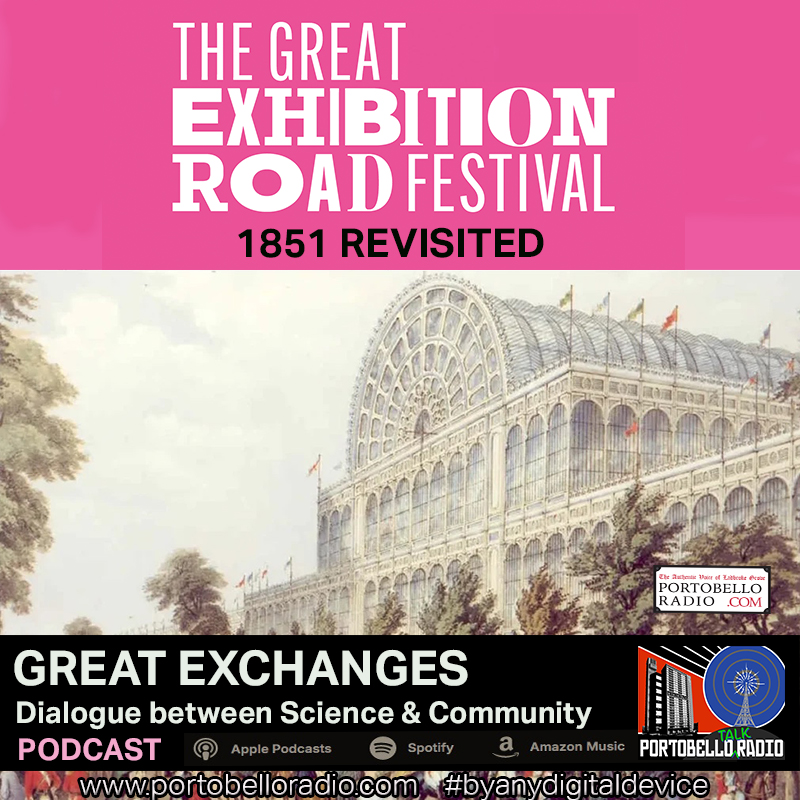
And it runs from May to October in 1851 in Hyde park in the building that was dubbed the Crystal Palace. It contains a huge amount of things, so it's got about 100,000 objects inside it, about 14,000 exhibitors of various kinds of. It has things from Britain and its colonies at the time, but also things from around the world. So the idea was to try and represent everything of interest at the time in terms of Technology and industry.
[00:03:26] Speaker C: And what were Albert and his co conspirators? What were they hoping to achieve by this grandiose event?
[00:03:34] Speaker D: Albert was very interested in science and the arts and so were many of the people who were on the committee with him, which would become the Royal Society of Arts.
They were really interested in inspiring competition, healthy competition in terms of manufacturing and engineering. But they also wanted to educate the public as well.
This was a kind of edutainment type of thing.
[00:04:01] Speaker C: A bit like the Millennium Dome.
[00:04:03] Speaker D: Yes. Although perhaps we should avoid the comparisons with that. Yeah.
[00:04:08] Speaker C: And what about some basic facts and figures? How many people attended it, how long did it go on for? And was it a hit?
[00:04:19] Speaker D: So it was a hit. By all accounts, it had around 6 million visitors during its opening, which ran from the start of May to about mid October 1851.
And the visitors were composed of different social classes. There was some contention about this throughout the exhibition's running about who could attend when and the cost of admission.
But it had 100,000 objects, about 14,000 exhibitors. The Times estimated that if you wanted to actually see everything, it would take you more than a month of going every day.
[00:04:57] Speaker C: What was the most spectacular thing?
[00:04:59] Speaker D: What a question.
I suppose the building itself was a real draw.
It was apparently 1,851ft long to mark the year. And it was at the bottom of Hyde Park. It's made of glass and metal. It's really unusual as a building. So it was designed by Joseph Paxton, who had actually previously worked on greenhouses at places like Chatsworth House, where he built a huge house for a giant lily.
And he transferred this technology of glazing and metalwork to the Crystal Palace. So you walked in and it was this huge atrium. There were trees inside it that were in the park and they'd built around the trees and you would just see stalls spread out in front of you and a mass of people.
One of the biggest things that people remembered was the fountain, which when you walked into the atrium, There was a 27 foot high pink glass fountain which had been commissioned by Schweppes, the drinks company. So if you look at a Schweppes bottle now, you see they adapted that fountain as their logo and it's still on their products now.
That fountain was like a meeting point.
When the festival closes in October, people dip their bottles in there and take some of the water out of the fountain as a souvenir.
[00:06:21] Speaker C: I'm no expert, but I think the most famous exhibit at the exhibition was the Koh I noor diamond. Can you tell us a tiny bit about that?
[00:06:33] Speaker D: So the Koh I Noor diamond is very famous. It's very well documented diamond. It was huge. It was about 106 carats, I think. And it was mentioned in texts in. In India in the 17th century. And it's taken by the British after the annexation of the Punjab in 1849 and is added to the Crown Jewels. It's one of the big draws to people coming to the exhibition, but in actuality they're quite disappointed because it's not as sparkly as they expect it to be. And so it's recut after the exhibition to make it more impressive.
[00:07:12] Speaker C: Ale, had you heard of the exhibition before you got involved?
[00:07:16] Speaker E: I think I have, yes. I'm not sure exactly where it must have been. Maybe in a history lesson.
[00:07:22] Speaker C: How did you get involved with the event?
[00:07:26] Speaker E: So actually it was through my youth centre called the Avenues Youth Project, and they left out a leaflet to promote the program.
And ever since then I just, you know, applied through there.
[00:07:40] Speaker C: Tell us a little bit about the young producers. How many of you are there and what have you been doing week by week?
[00:07:47] Speaker E: So there's eight of us in total. And from the start up till now, we've been having various discussions with our heritage researcher, Christina, along with Chloe, our artists. We're learning about different definitions and breaking them down, such as imperialism and extraction, learning about what they mean. And, you know, we also decipher that through. Through drawing. What could. What does that look like? So, and also analyzing images from the past and chatting about that. And also, you know, we spoke about exoticism, which is really interesting. And we learned about the. The history of textile trade, trade making that the British had with India. We learned about the Indian Chap ticket, which it's basically.
It was basically a textile ticket. And like, discussing, like the.
Like talking about the posters and how they looked.
And we also learned about the colonial context of them too. We also, as I said, we transformed abstract ideas into like, objects. Also we took a very creative approach for this. That's what we've been doing. And also we've been doing a bit of acting from time to time and, like, trying to act like certain Personas that attended the Great Exhibition Festival, like making storyboards.
But it's also been complemented by our trip to the National Archives, which was, I think a month ago, and we saw records of items, displayed the sketchings of the buildings in the past. And I saw the drawing, like a sketching of the Kohinoo diamond.
It was Great, because I learned the skill of interpreting and building clues together, which is what you need as an archivist.
[00:09:43] Speaker C: What were your first. Once you began to learn a little about what the exhibition was about and why it was there, what were your first impressions?
[00:09:53] Speaker E: When I was first, like, deciphering everything, I was thinking, like, this was a very grand event for its time and it was amazing how.
How many people were involved in this and stuff. But also it's important to realize how a lot of these stuff were, like, from these colonies and obviously kind of in. It kind of involved exploitation. And I was learning all about that through, you know, my program picking up on that point.
[00:10:28] Speaker C: The colonies who were showcased in this event, did the people in those places have any input at all, or was it very much driven from the centre? Here in London, it's the British.
[00:10:43] Speaker D: The British part is very much driven from the centre. So it wasn't entirely just the London committee who was running things. So they appointed local committees throughout the country who would then be responsible for, like, calling for participants to submit objects for exhibition. And then that local committee would. Would make the decision.
And in terms of the colonies, it would really be the British colonial officials who were tasked with that kind of thing. For the other countries that were not in the empire, they were getting in touch with the foreign ambassadors and people in those countries where the royal connection really helped as well.
[00:11:23] Speaker C: Elle, which bits of the exhibition interest you? I mean, would you have enjoyed going. Would you have queued up to go on whichever day you were allowed?
[00:11:34] Speaker E: I would have actually really enjoyed it, I think, particularly because it would have been. I've been like, seeing new creations and stuff. As I said, these were all things that people have never seen before.
And suddenly it was like a big, like, global view. Like they had stuff from, you know, India, like furnitures, jewelry. They even had, you know, I think, raw materials from the Caribbean. So it was like a feast for their senses.
[00:12:03] Speaker C: Yeah, I would go, we know and love Exhibition Road. Now for is it, I think, 22 August institutions from down at the bottom, the VA and the Natural History Museum, going all the way up the top to the Science Museum and Imperial College itself. What was the connection between what happened in the Crystal palace and the institution institutions that grew up afterwards?
[00:12:30] Speaker D: So Albert was really keen to have a centre for education and culture and the arts and the sciences. And the surplus profits that was made from the exhibition, which amounted to about £186,000, was put towards the purchase of this broad swathe of land which we now call Albertopolis. Perhaps some people will know it as where all of those institutions that you mentioned, so that is how that comes into being.
[00:13:00] Speaker C: They didn't have a dinosaur or blue whale though.
[00:13:03] Speaker D: No, although they may have done not a dinosaur but possibly there were quite a lot of taxidermied animals but the focus was more on industry so it was more machinery that began the collections in the museums.
[00:13:17] Speaker C: An early steam event.
[00:13:20] Speaker D: Yes.
[00:13:22] Speaker C: You're coming to this obviously. 175 years later it's beginning to sound a little bit exclusive. We've heard about VIP days for different classes.
Obviously it seemed to celebrate at the time the exploitation of countries all around the world. How does that feel to you? Does it just seem like a moment in time or is it shocking?
[00:13:52] Speaker E: I wouldn't say it necessarily shocks me but it's, it's quite like, it's quite intense to see it all in play. Like how, you know, because of all of like these colonies and this exploitation they were able to create like a big like exhibition which I would say really like.
Yeah, it was, I don't, I wouldn't say it's like surprising but it was really interesting to see, see how it like affected the colonies and stuff.
[00:14:23] Speaker C: Jen, what was the reaction at the time in 1851? Because 6 million people, I mean that must have been about 20% of the whole population at that point.
[00:14:34] Speaker D: So initially when they begin to plan the building for the Great Exhibition, there's quite a lot of resistance from local residents because. Because those areas just around the edges of the south side of Hyde park had just only recently in the previous 20 years begun to be developed with housing and quite nice housing as well. So these people were quite worried about what this would do to their property values to the area.
They even got up a petition to Parliament to try and stop it. But it still goes ahead.
The reactions of people as visitors or non visitors who adamantly refused to go are quite varied.
So some of the more surprising reactions perhaps are religious groups who didn't like the fact that this was focusing on material goods. And many religious groups actually produced pamphlets and guides about how people could read the exhibition in a proper Christian way by thinking about Providence.
The other people who objected were sometimes the more radical press.
So Reynolds knew, for instance, frequently ran pieces critical of the Great Exhibition saying that this was detracting attention from bigger political issues of the day and also that it didn't pay attention to many of the working class labourers who were behind the construction of many of the exhibits.
Even before the exhibition ran, Punch magazine was Anticipating that maybe some of the exhibits could include a distressed needle woman and whether the exhibition was going to recognize laboring plights at the time.
[00:16:20] Speaker C: Because this is only three years after the revolutionary year of 1848, when we're about the only country that didn't have a revolution.
[00:16:30] Speaker D: Although we did have a big Chartist demonstration in London, which was really quite an event, actually. And I think when we think about the 19th century, we often pinpoint the Great Exhibition as being emblematic of the 19th century and the Victorian era. But for many people at the time, that 1848 Chartist demo was just as important.
[00:16:52] Speaker C: Ele, have you been considering how we might, if we were to put on the Great Exhibition, build a Crystal palace now? Have you thought a little bit about how we do it now?
[00:17:05] Speaker E: I think people that are like, behind the scenes should be credited more and really be involved in the scenes, because it wasn't really like that for 1851 at all. We had no idea really of who made those pieces and stuff like that. So that's what I would change if you were to do it now around here.
[00:17:27] Speaker C: Around that period, of course, we'd had a lot of people pushed out of the West End, and that's when the piggeries and the potteries grew up in Notting Dale.
What was the effect of the Great Exhibition in terms of the growth of West London?
[00:17:47] Speaker D: Yeah, I mean, if you look at maps from the 1840s, pretty much from like where Kensington High street is down to the river, which was largely fields, as you say, although not necessarily lovely rolling, open countryside. But a lot of that was market gardens, so places that were producing fruit, vegetables, flowers for the London market.
With the 1851 exhibition, obviously the land value goes up significantly around Kensington and Belgravia. So all of those fears of the locals who thought that they. Their area was going to be ruined were pretty much unrealised. And when you look at maps towards the end of this century, you can see that a lot of that western area that previously was Market Gardens is pretty much covered in building.
[00:18:37] Speaker C: 1851 is obviously the Industrial Revolution is in full throttle. Was there an excitement about some of the technological advances that were showcased at the Exhibition, or was it just people wandering around gawping with their mouths open?
[00:18:56] Speaker D: I think there was a little bit of birth, to be honest. There would be people who had really gone to see their pet's object or their pet interest, but the majority of visitors, I suspect, were just so overwhelmed by the amount of things and the amount of people you would be Kind of swept along with the crowd often that whether you actually got to engage in a very detailed manner with any of the exhibits is questionable. Although some of the. There were big working machines in there. There were things like printing presses which were running. So you could see these things in operation as well.
One of the most interesting things is the way that some of the exhibitors were able to almost conduct experiments within the building. So there were scientific instrument makers who are exhibiting thermometers and things like this. And that contributes to daily temperature readings of the Crystal palace that are printed in the papers so that people know how hot it is when they go in. So at the height of summer, it reaches something like 36 degrees inside. And apparently ladies were fainting.
[00:20:08] Speaker C: Of course, all that glass. It's a greenhouse, isn't it?
[00:20:11] Speaker D: It is. Exactly.
[00:20:12] Speaker C: What's the single most exciting thing that you've learned about the Crate Exhibition?
[00:20:18] Speaker E: The most exciting thing I can't pinpoint, but it's been many things, I think, particularly learning about the origins of the Paisley design from India. How it was obviously massive manufactured. And he was named Pacey due to the place in Scotland. It was great to learn about the textile history. Not only this, but also this was. I found out that Barbados was the most profitable colony of the British Empire. And I had no idea because I thought it was India.
[00:20:54] Speaker C: Will textiles be involved in the final piece?
[00:20:57] Speaker E: Most likely, yes.
[00:21:00] Speaker C: By this time, of course, we've not only had Wilberforce ending the slave trade as far as we could, and then you've also had the emancipation in 1834. I think with 17 years past for I suppose the British, the days of slavery, it's still going on very much in america because we're 10 years before the Civil War starts.
Does the slave trade, is it built in to the Great Exhibition?
Could it exist without the profits from slavery?
[00:21:36] Speaker D: It's something that I think is present throughout a lot of industry of that era. And it's very difficult to imagine a lot of those industries, sugar for instance, without the slave trade.
There was one interesting protest, or semi performance if you like, at the Exhibition.
There was in the American section, there was a statue from 1844, a marble statue called the Greek Slave, which was very famous, had been exhibited throughout America and America sends it to the Great Exhibition.
And the statue represents a white Greek slave girl who is represented as being very beautiful, as being Christian. She's got a crucifix wrapped around her wrist.
And this was the focus of a couple of people who were living in England at The time who were actually fugitive American slaves.
They were William Wells Brown and Ellen Craft. And they have a day where they go to the exhibition as visitors and they promenade around them for about seven hours arm in arm with their white companions.
So they are visitors, they are kind of, they are exhibiting themselves but in terms of equality rather than curiosity, as had been previously the case. And they end their promenading next to this statue in the American section. And they place next to the statue a cartoon that had been published in Punch magazine by John Tenniel, which compared the Greek slave exhibit with an imagined exhibit of a black American slave.
[00:23:24] Speaker C: Alain, you've been working with the other young producers and no doubt many of you have connections with some of those countries that were portrayed in the exhibition.
How's that been seeing the countries that where you have connections being represented by essentially posh white people in the middle
[00:23:48] Speaker E: of London, it feels quite like, quite, I guess a bit surreal because we have many people like that are from, I think like South Asia. And of course they did represent those objects. And it's interesting to see how, you know, like her cultural heritage was displayed there.
You know, people were making different like perceptions on it and viewing it in different ways. And it was also interesting to see. We analyzed a picture of the Great Exhibition festival and it showed, or not just like English people, but also Indian Indians that visited the exhibition. And we were just kind of constructing how they would have viewed it. Like we were discussing. Would they have been taking pride in that? Would they have been like kind of annoyed about that? So we were just trying to analyze their perceptions because there's different types of audience that were there. And also for the Caribbean we saw that the heritage researcher, Christina, she, she's from Barbados and it was interesting to see that a lot of the stuff were actually from Barbados.
But yeah, I think it's quite interesting actually.
[00:25:09] Speaker C: Jen, are there any current contemporary accounts critiquing the exhibition?
[00:25:16] Speaker D: There's lots of accounts scattered around the press at the time. So many of the more left leaning radical newspapers are quite critical of it. There are major figures who don't like it. William Morris, John Ruskin are quite critical.
That kind of criticism comes more to the fore a bit later in the Indian and colonial exhibition in 1886, which is held just over the road in the heart of Albertopoulos, where obviously that is, it's opening itself up to that criticism really in the focus. And there's interesting accounts from that of Indian visitors who go and talk about the racism that they encountered, but also their shock at the poverty they saw in London.
This idea that this grand city that touted itself as the centre of the Western world also had horrendous poverty next to immense wealth.
[00:26:17] Speaker C: Would visitors have seen any of that poverty had they? I mean, in the same way that whenever the Olympics comes to a city, they seem to flush out anyone who, you know, isn't respectable.
Was that something that happened at the time?
[00:26:31] Speaker D: Definitely. So when they are building the Crystal palace in Hyde park, they move on lots of street sellers who had their established stalls around that area. So there's one elderly street seller who has her pitch just next to the Serpentine and she adamantly refuses to move until she's given compensation of about 90 pounds, which is quite a lot for her at the time. But obviously when the exhibition starts, the influx of crowds means that the thoroughfares towards the Exhibition are full of people selling things in the street and begging.
[00:27:10] Speaker C: Yeah, I mean, that is absolutely echoes of what happened in London in 2012 and they knocked down all those street markets and so on to build the Olympic Park.
Can we compare the Great Exhibition Road Festival, which brings these great institutions together, you know, very forward, public facing way, trying to bring the general public into the excitement of what's going on, particularly in engineering and science, but also in art. Can we compare the two?
[00:27:45] Speaker D: That's a good question. I think obviously the kind of things on show and the type of things that are being encouraged in terms of interests and interest in science and education, about science, certainly that is very similar.
I think the festival is obviously a bit more inclusive, for one thing, perhaps more mindful of how it presents things.
Obviously, we're now very aware of the imperial and the colonial aspects of the Great Exhibition. And those are things that we would interpret very differently.
Although we shouldn't assume that people at the time just blindly accepted these without comment either, because there were criticisms and there were quite interesting critiques of that aspect of the exhibition.
[00:28:37] Speaker C: It's 175 years later, but there are some of the same concerns. The white heat of technology and what's it going to mean for us mere mortals.
[00:28:48] Speaker D: Yeah, and I think what we forget is that a lot of the anxieties we have now about people being put out of work by machines, about AI, about all those debates. They are very similar to a lot of the late 19th century debates around technology.
The Victorians were very understanding, I suppose, of how these would affect things like labor relations and people's ability to showcase their own skills. And that is something that that carries through time. So now when we talk about people's resistance to AI, for instance, it's just dismissing that as being Luddite, for instance, is not really helpful. It's that kind of worry about change and new technology is something that has been around for years and probably won't change.
[00:29:43] Speaker C: You are also giving. You're part of a panel. What are you talking about? And can we get.
[00:29:49] Speaker B: Are there tickets left?
[00:29:51] Speaker D: I believe there are tickets left.
We will be in the VA Lecture Theatre, which is a very appropriate place obviously, and I'll be joining some other histor historians to talk about the legacy of the Great Exhibition and our various historical interpretations of it, which obviously change over time as our own sensibilities change.
[00:30:12] Speaker C: Ale, do you know which zone you're in?
Next gen. Next gen. Great zone.
Thank you so much, both of you. Ale, Jen, thank you. We look forward to seeing you on the 6th and 7th of June in Exhibition Road.
[00:30:28] Speaker B: Thanks for listening to great exchanges at
[00:30:30] Speaker C: Portobello Radio, co production with Imperial College London.
[00:30:34] Speaker B: The other shows are available wherever you find your podcasts. See you next time.
[00:30:40] Speaker A: You are listening to Portobello Talk Radio, the authentic voice of Letbrook Grove.